
Interview: Karen Naundorf
Interview
Fascinated by cosmic radiation
Dr Karen Salomé Caballero Mora is researching one of the greatest mysteries in astrophysics – within an international alliance of 17 countries.
Issue 1 | 2026
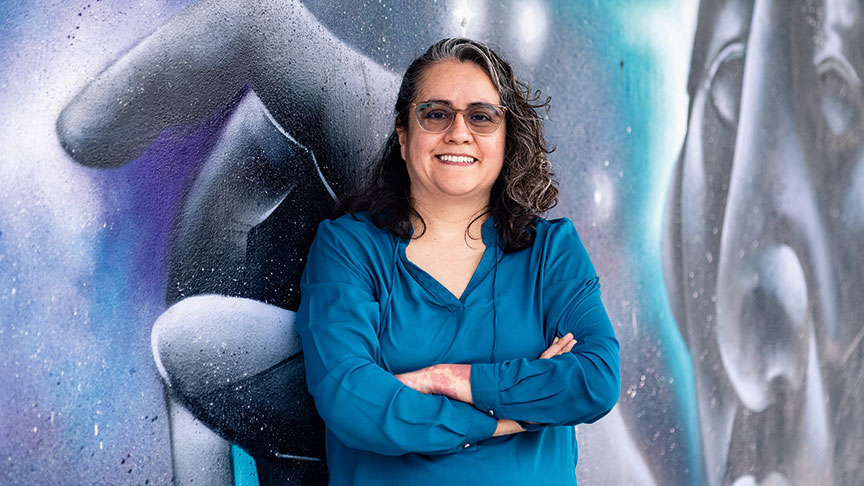
Ms Caballero Mora, you are Mexico’s representative in the research project being conducted at the Pierre Auger Observatory on Argentina’s “yellow prairie”. Why is this major experiment so crucial to gaining a better understanding of cosmic radiation?
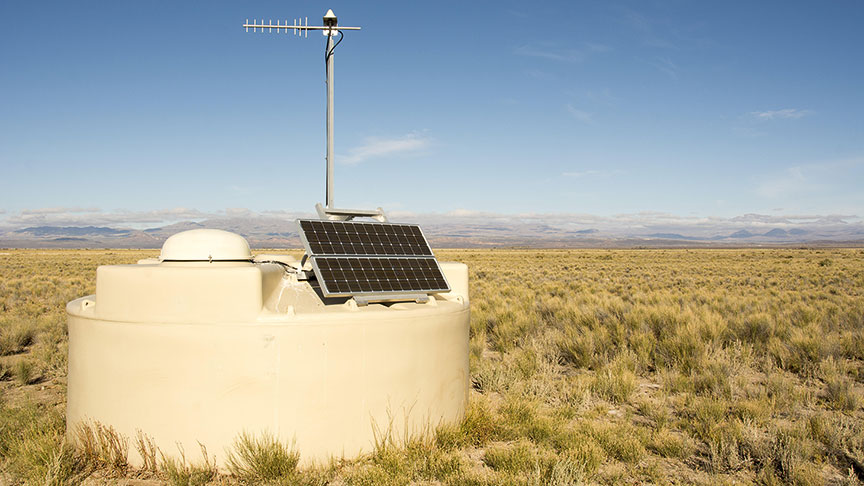
Karen Salomé Caballero Mora: The Pierre Auger Observatory is the world’s biggest facility for studying ultra-high-energy cosmic rays. The facility measures particle showers in the atmosphere that occur when cosmic radiation collides with air molecules. The experiment allows us to measure the properties of the particles, which is the first step towards getting to grips with some of the fundamental questions of particle physics and astrophysics.
High-energy cosmic radiation is one of the great unsolved mysteries in astrophysics. What are you hoping to learn from this?
Caballero Mora: About the composition of the most energetic particles, for example: are they protons, or are they lighter or heavier atomic nuclei? Answering this question will enable us to get a clearer picture about where they come from and which processes in the universe give them the energies they have when they reach the Earth’s atmosphere. This is what makes this field of research so exciting: these energies cannot be artificially produced on Earth. Even the biggest particle accelerators aren’t able to achieve them. Yet we are constantly surrounded by cosmic rays without most of us even knowing they exist. That said, capturing the particles is extremely difficult!
The Observatory covers an area of around 3,000 square kilometres: why is such an enormous area needed for these measurements?
Caballero Mora: Because the highest energy events are extremely rare. Statistically speaking, only one of the most energetic particles reaches the Earth per square kilometre and century. That’s why a very large area is needed to measure such events; in fact, it’s the only way to increase our chances of detecting them at all. What is more, the particle showers that occur in the atmosphere can spread out across many kilometres – another reason why an observatory of this size is necessary.
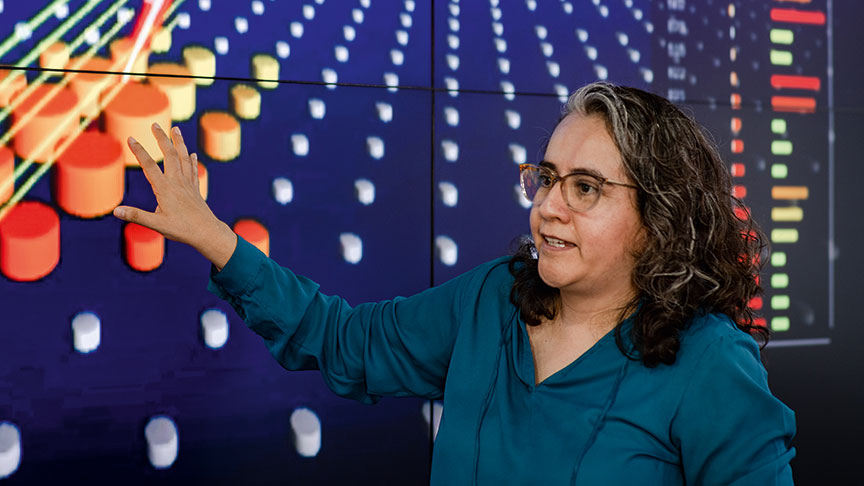
To what extent does this research go beyond ground-based observations?
Caballero Mora: Besides the ground-based observatories, there are also instruments installed on satellites outside the Earth’s atmosphere. They can observe cosmic radiation more directly, and across a wider field of vision. In this context, we are also interested in aspects such as antimatter. Many of our colleagues in astroparticle physics are therefore working at the same time on developments for space exploration or on scientific instruments in space. This is a good example of the very close ties between basic research, astroparticle physics and space research.
People sometimes have a tendency to mock basic research, or at least criticise it and question its value. What can a project such as the Pierre Auger Observatory do to highlight the importance of basic research?
Caballero Mora: Basic research takes time. One famous example is the Higgs boson, a particle that has already been described on a theoretical basis in the 1960s but not experimentally proven until 2012. At the Pierre Auger Observatory, we address questions of fundamental physics. Such experiments lead to technical developments that extend far beyond the individual project. Basic research is the foundation on which much else is built.
How important is international cooperation for this project?
Caballero Mora: An observatory of this size can only be run and developed if resources are provided by many countries. The participating groups contribute knowledge, equipment, personnel and funding. They also help to operate the infrastructure on site. International cooperation is not a useful add-on here, it’s an essential prerequisite. Questions of this nature cannot be answered at the national level.
“Basic research is the foundation on which much else is built.”
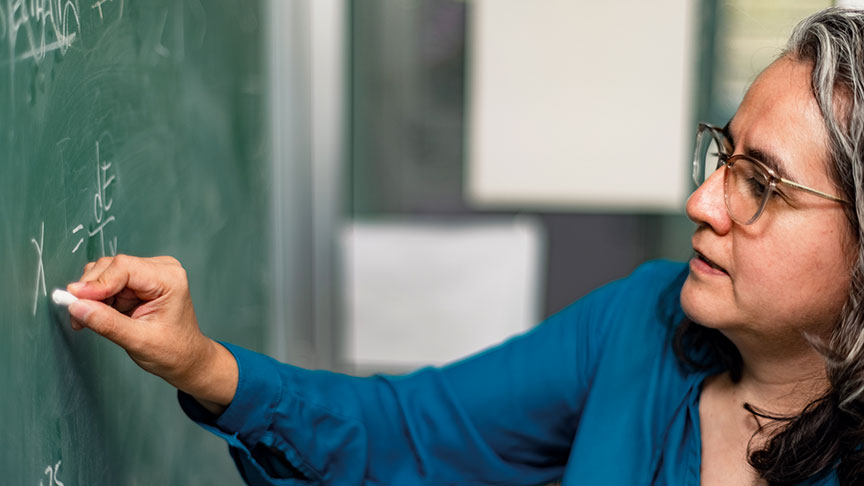
How did you end up working in this field of research?
Caballero Mora: It all started with astronomy. At school I found this subject very fascinating and later, at university, I realised that astroparticle physics interested me even more because it combines so many different aspects: astronomy, particle physics, mathematics, data analysis and computer science. I discovered the field only gradually: at my department I spotted a notice displayed by Lukas Nellen, a German physicist at the Universidad Nacional Autónoma de México (UNAM). This led to a lengthy exchange that introduced me to the subject bit by bit. And it became clear to me that many of my interests converged here.
Ultimately, those interests led to you doing a PhD in Germany. What did you find so appealing about that idea?
Caballero Mora: It was my final thesis in Mexico that mapped out this path for me. In it, I wrote about a topic relating to the Pierre Auger Observatory before I had even been there myself. Then I applied to the CONACYT programme run by the DAAD and Mexico’s National Council of Science and Technology. At the time, I was interested in Germany not only for scientific but also cultural reasons. I had spent several years learning German in Mexico. I knew that going to Germany was a great opportunity for me career-wise. The Pierre Auger Observatory seemed to me like the ideal place to do research at the time – and for my colleagues at the Karlsruhe Institute of Technology (KIT) it was already a reality.
How did your time in Germany benefit you on a professional and personal level?
Caballero Mora: On a professional level, it taught me above all discipline, order and scientific precision. At the same time, it made me realise that I’d had a very solid education in Mexico. My time in Germany left just as much of a mark on me personally: I was living on my own for the first time and had to find a flat and deal with insurance, banking, taxes and everything else related to my stay. I also found myself in an international environment, speaking German, English and Spanish on a daily basis. This multilingual setting and the chance to engage with people from many different countries significantly influenced my view of science and cooperation.
Discipline and precision are one thing – but being passionate about asking why is another. When did you first realise that you are more fascinated than other people by natural phenomena?
Caballero Mora: Even as a child I always wanted to find an explanation for things. I would wonder why the moon seemed to accompany us as we were driving home, why a wooden bathroom door would swell up and then return to normal or why animals suddenly start behaving differently during a total solar eclipse. As far as the wooden door was concerned, I even began noting down the times to see how long it took to swell up and then return to its normal size. Later, I did a course in electricity and electronics at school that taught me about electric circuits and magnetic fields. That’s when I also began conducting experiments at home. I didn’t tell my parents at the time that I was responsible for a power outage, though.
What wisdom are you keen to pass on to your students today?
Caballero Mora: Above all, to have courage and to believe in their own abilities. Much of what I have achieved was possible only thanks to very hard work, persistence, support and funding. All I had was my ability to apply myself and do my work. I tell my students that a similar path is also open to them. I feel it’s especially necessary to communicate this to young women because we are still in the minority in many fields of physics. That’s why it is so important
to be visible and to support one another. —
Dr Karen Salomé Caballero Mora is a professor at the Autonomous University of Chiapas (UNACH) in Tuxtla Gutiérrez in Mexico and Mexico’s national representative in the Pierre Auger Collaboration in Argentina. While doing her PhD at what is now the Karlsruhe Institute of Technology (KIT) from 2004 to 2009, she received funding under the CONACYT programme co-financed by the DAAD and the Mexican National Council of Science and Technology.