
Text: Christina Henning
In action
Making the invisible visible
DAAD alumnus Leonardo Alvarado is an atmospheric physicist. He uses satellite data and algorithms to track down harmful trace gases – as the basis for more targeted environmental protection.
Issue 1 | 2026
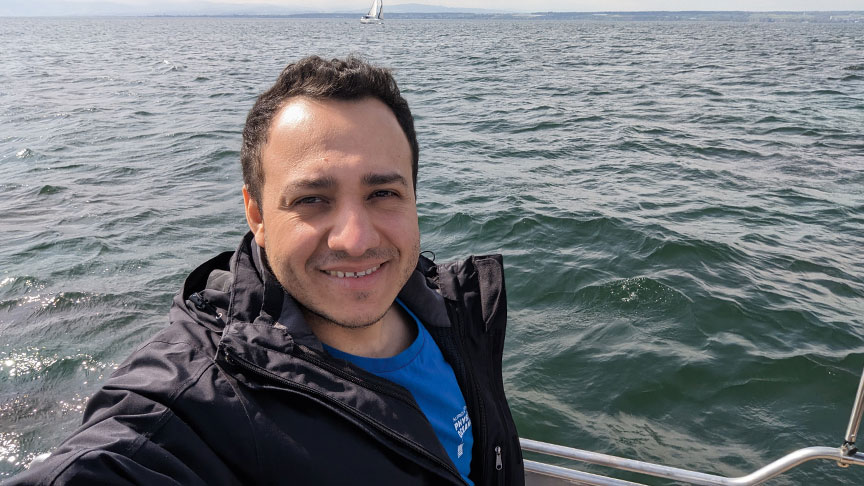
Destructive wildfires tore through large swathes of Canada’s forests in the summer of 2018. The fires had a devastating effect, with the plumes of smoke even showing up on satellite images from space. What Leonardo Alvarado was interested in was not visible to the naked eye, however: harmful gases that were released by the fires and scattered across long distances through the air – even to regions more than 1,000 kilometres away.
This was what Alvarado discovered while pursuing his PhD and during his subsequent postdoc phase. He left El Salvador to do his doctoral degree at the University of Bremen on a DAAD scholarship in 2011. Today, 15 years later, Alvarado works at the German Aerospace Center (DLR) in Oberpfaffenhofen near Munich. He may be in a new place, but the subject of his research hasn’t changed: in the Atmospheric Spectroscopy department, he is still studying substances in the Earth’s gaseous shell – and how they influence life down here.
At the DLR, Alvarado uses the DOAS method, an abbreviation that stands for differential optical absorption spectroscopy, to analyse the sunlight reflected by the Earth. The way this light changes in the atmosphere allows conclusions to be drawn about the trace gases it contains – gases which occur in minute quantities in the Earth’s atmosphere. Although they account for just a fraction of the air, they have a considerable impact on our climate and environment. Alvarado can use satellite measurements to determine the quantities in which substances such as nitrogen dioxide, chlorine dioxide, ozone or formaldehyde are present in the atmosphere and what consequences this can have for air quality. “Certain trace gases can negatively impact our health. Nitrogen dioxide for instance irritates the eyes and nose, while formaldehyde can entail serious health risks,” explains Alvarado.
He obtains the data from satellites for example from the Sentinel‑5P mission, which monitors the Earth’s atmosphere from space. Sentinel is part of the Copernicus programme that is being implemented under the aegis of the European Space Agency (ESA).
Alvarado believes that his work plays an important part in helping researchers to better understand processes in the atmosphere while at the same time raising awareness of environmental pollution. Environmental agencies and meteorological services use his research as a basis for assessing air quality, monitoring developments and taking action or making recommendations whenever necessary. Leonardo Alvarado is convinced: “Good monitoring leads to good policymaking.” —
Meet Leonardo Alvarado in our video portrait.