
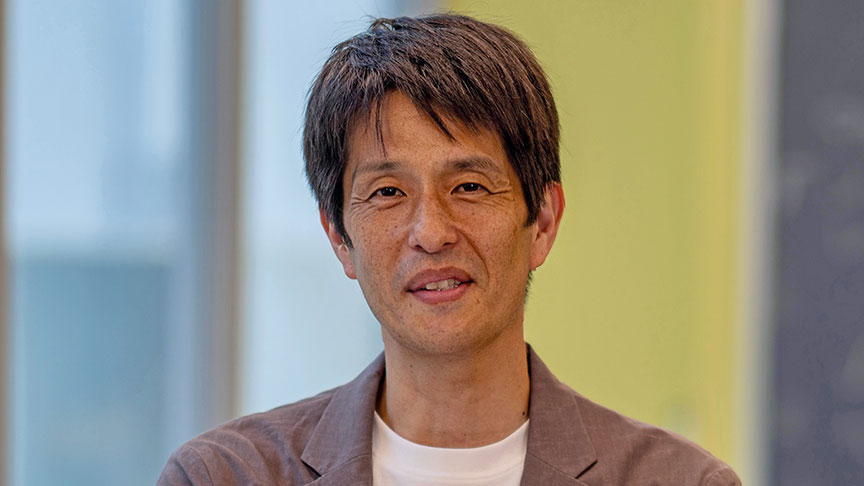
Professor Yoshida, you are using astrostatistical methods to research the early history of the universe. Can you explain what this means?
Naoki Yoshida: Ever since its earliest beginnings, cosmology has involved pioneering achievements in data science: it is the result of discoveries made by people who gazed up into space and recorded all the information they could see. These days, modern telescopes provide us with literally astronomical quantities of highly complex observation data. They enable us to look back into the early history of the universe: what happened in the hundreds of millions of years after the Big Bang, when the universe gradually cooled as it expanded and initially atoms, then stars, galaxies and black holes emerged? At the Kavli Institute for the Physics and Mathematics of the Universe at the University of Tokyo (Kavli IPMU), we build mathematical simulations that allow us to analyse the huge quantities of unsorted data from telescopes on supercomputers. By comparing the results with theoretical astrophysical models, we can draw important conclusions about the way our universe emerged and evolved.
Could you give an example?
Yoshida: Using highly complex computer simulations, among other things, we looked into the question of where the lion’s share of dark matter is actually located. This is the invisible substance that comprises most of the universe, yet we know nothing about its nature. We have been able to demonstrate that dark matter is distributed in clumps, but in an orderly fashion: galaxies have extensive fringes made up of dark matter that go far beyond the area in which stars exist. This finding is also interesting in that it explains why the total cosmic mass density is greater than the mass of all the galaxies added together. There’s no empty space in the universe, as intergalactic space is filled with dark matter.
Currently, major space missions are underway to learn more about the properties and nature of the universe. To what extent is the exploration of space relevant to your research?
Yoshida: It is indirectly relevant to this, which is why I followed the successful Artemis 2 moon mission with such great interest. If the Artemis programme achieves its goal of building a station on the moon in the medium term, far more precise astronomical observations will be possible because the moon has no atmosphere. A series of large-scale observation programmes using ground- and space-based telescopes is planned for the next decade. It will only be possible to process these vast quantities of complex data if we use fully automated technologies based on machine learning and artificial intelligence. That poses a serious technical challenge.
When did you discover your interest in astrophysics?
Yoshida: When I was nine I was given a telescope as a present and loved stargazing from our balcony at home in a suburb of Kobe. That’s not to say that my path was already mapped out by then, however: my favourite subjects at school weren’t maths and physics, but literature and history. After some dithering, I decided to study aerospace technology at the University of Tokyo. During my master’s degree I spent a year as an exchange student at the Royal Institute of Technology in Stockholm. I took advantage of this wonderful period in my life to see as much of Europe as possible. I was particularly taken with Munich, which is why I ended up doing my doctoral thesis at the Max Planck Institute (MPI) for Astrophysics in Garching. Another argument in favour of the MPI in Munich – besides the outstanding research conditions there – was the good Bavarian food, Riesling and of course beer! Those years, between 1998 and 2001, marked the start of my scientific career, and I’m very grateful for the DAAD scholarship that made this possible for me. I subsequently worked as a postdoc at the Harvard-Smithsonian Center for Astrophysics in the USA, and then returned to Japan in 2003.
The Alexander von Humboldt Foundation’s Philipp Franz von Siebold Award you won in 2024 was in recognition not only of your groundbreaking scientific achievements but also of your services to fostering mutual understanding of culture and society in Germany and Japan.
Yoshida: The award means a lot to me because I feel strong ties to Germany. I continue to collaborate with the MPI for Astrophysics and Ludwig-Maximilians-Universität München and travel to Germany several times a year. At the University of Tokyo I organise biannual workshops with European – and above all German – researchers, and I’m also in regular contact with the DAAD Regional Office in Tokyo. I see myself as a builder of academic bridges between Japan and Germany. –