
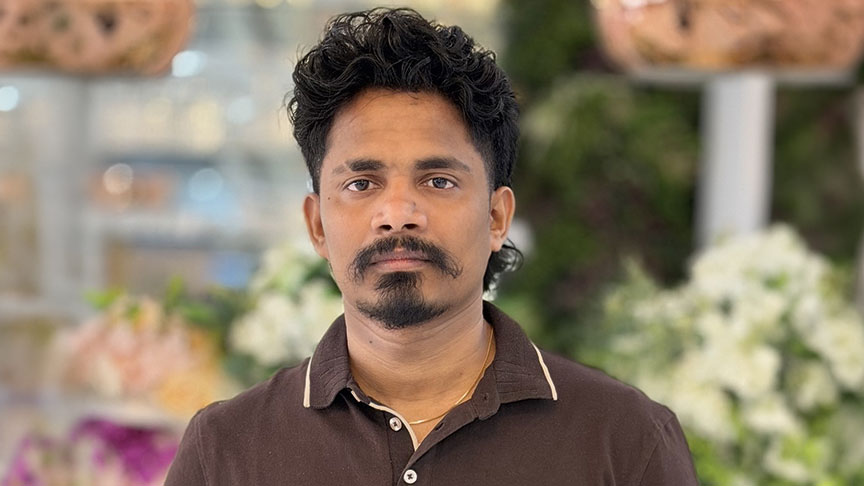
“I’ve done lots of different things – and have also changed direction a number of times,” recalls Nirujan Rameshkumar. “I’ll be interested myself to see where my journey will take me.” Rameshkumar’s academic career began in 2017 at the University of Jaffna, where he conducted research on sponges during his degree course in marine biology. “I realised that what interested me most of all was academic research.” He discovered his passion for neuroscience while working as a research assistant in the Vaithianathan Lab at the University of Tennessee Health Science Center in Memphis, USA. “I studied the retina of zebrafish in order to gain a better understanding of its physiology.” The work he is now involved in as a doctoral student at the German Aerospace Center in Cologne builds on this research. “For my PhD, I am looking at how microgravity affects human neuromuscular synapses in 3D tissue models made of stem cells.” Rameshkumar grows these human-induced neuromuscular organoids (iNMOs) in the lab. He then sends them into space – and soon will even be sending them to the International Space Station (ISS). His research aims to develop strategies for countering the adverse physiological impacts of space travel on astronauts. As a fellow on the DLR-DAAD Research Fellowship Programme, supervised by Dr Christian Liemersdorf from DLR and working in collaboration with Dr Volker Busskamp’s laboratory at the University Hospital Bonn, he sees himself as being in the perfect research setting: “It’s easy to share ideas and discuss my work with other departments, the working environment is first-class – and my colleagues are simply the best.” —
Engaging in exchange
From the bottom of the sea to outer space
Sri Lankan scholarship holder Nirujan Rameshkumar studies gravity’s effects on human cells.
Issue 1 | 2026